Israel's 77.7% Turnout Leaves No Bloc Able to Command a Majority
Likud and Yashar both fall short of the 61 seats needed to govern, forcing a choice between fragile coalitions or a return to the polls.
By Jonathan Ramirez ·
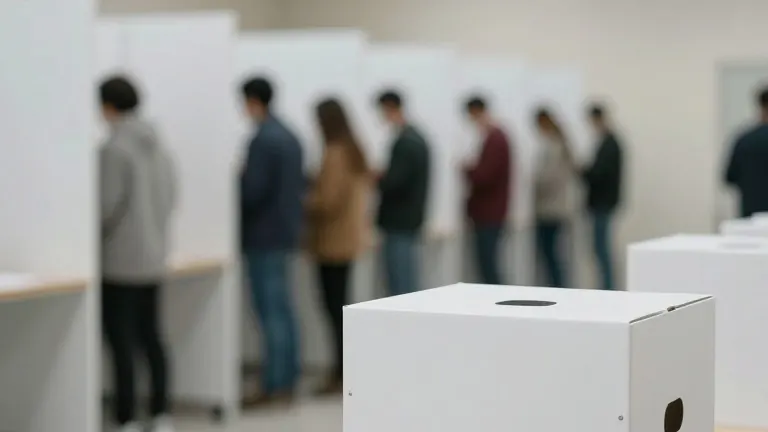
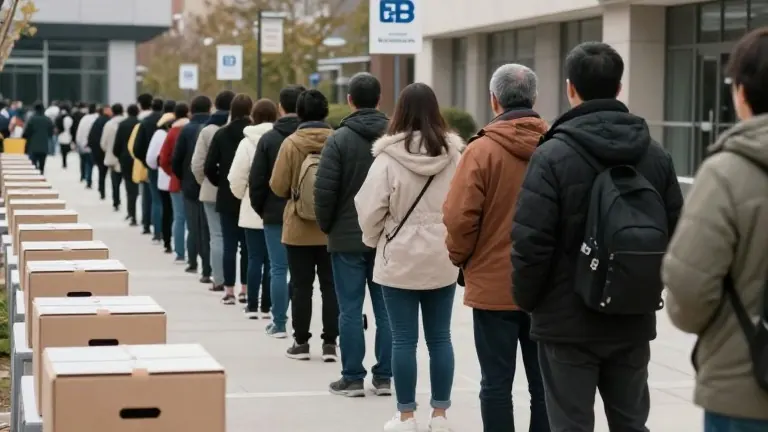
No political camp in Israel can form a government on its own after Tuesday's parliamentary election, despite a record 77.7% voter turnout. Early counts show Prime Minister Benjamin Netanyahu's Likud party on track for up to 28 seats, while his main rival, Gadi Eisenkot, leads the Yashar party with approximately 22 seats. Neither the right-wing and ultra-Orthodox bloc nor the center-left "change" bloc appears capable of reaching the 61-seat threshold required to control the Knesset.
Arab parties, which both major camps pledged to exclude from their coalitions, are projected to win at least 17 seats combined. This bloc has positioned itself as a potential kingmaker in determining the next prime minister. President Isaac Herzog is expected to begin formal consultations with party leaders next week to identify a candidate who can assemble a working majority.
Analysts outline three primary paths forward. The first involves a coalition between the change bloc and Arab parties. Although most change bloc leaders campaigned against such an alliance, Ra'am leader Mansour Abbas has offered cooperation. Yohanan Plesner, president of the Israel Democracy Institute, noted that this option is mathematically viable but contradicts campaign promises, citing a public that is deeply unprepared for an arrangement with an Islamist faction following the October 7, 2023, attacks.
A variation of this scenario involves a minority government supported externally by Arab factions. This configuration could include Yashar, B'Yachad, Yisrael Beiteinu, and the Democrats, potentially reaching 65 seats with outside support. However, Avigdor Lieberman has rejected the idea, and Prof. Jonathan Rynhold of Bar-Ilan University suggested he might agree only if he were the prime minister.
The second scenario is a unity government combining elements of both camps. Plesner suggested Netanyahu might prefer this route, keeping his core right-wing parties while attracting one change bloc party. Change bloc leaders would likely demand the exclusion of far-right or ultra-Orthodox parties that have resisted military draft reforms. Plesner acknowledged that many voters who sought Netanyahu's removal might feel betrayed by such an outcome.
The third possibility is a repeat election. Eisenkot argued against this path given the high turnout, but Plesner noted that a new vote could benefit Netanyahu, who would remain interim prime minister. Gideon Rahat, a political scientist at the Hebrew University of Jerusalem, stated that entrenched ideological divides make a new election plausible. Plesner predicted that resolving the deadlock may take weeks or months.
Voters participated in the highest number of elections since 1999. The next government will depend on whether parties can bridge the gap between their stated preferences and the arithmetic of the Knesset. Formal negotiations begin next week.