European Youth Unions Challenge Welfare State Decline Across Multiple Nations
Protests in France, Spain, and Italy have shifted from local grievances to a coordinated critique of intergenerational inequality and rising costs.
By Rafael Collins ·
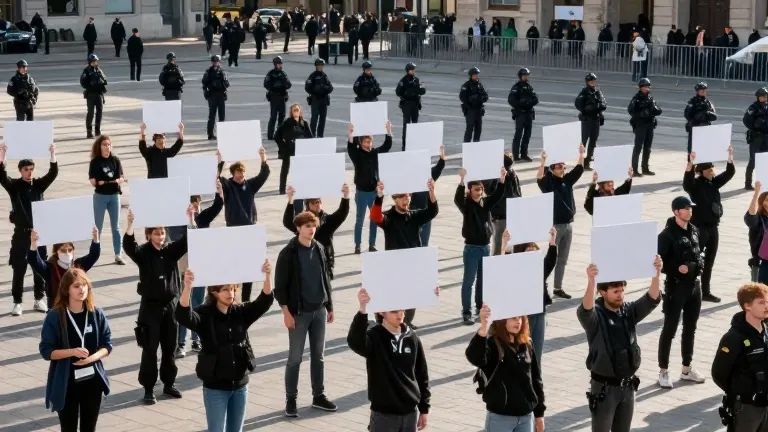
Protest waves are sweeping across Europe, driven by young people who feel cut off from economic stability and political influence. In France, demonstrators took to the streets over deteriorating education conditions. In Spain, the eviction of long-time tenant Maricarmen from her apartment in Madrid sparked a camp at Puerta del Sol. In Italy, unions and students are contesting the government's war economy measures.
The unrest has expanded to include Portugal, Belgium, Albania, and Serbia. In Serbia, President Aleksandar Vucic resigned in September after losing an early election to a student-led movement this week. While some demonstrations in Paris and Germany turned violent, the core demand remains the same: a response to the weakening of the European welfare state.
Yanina Welp, a senior researcher at the Albert Hirschman Center on Democracy in Geneva, identifies a common thread in these movements. She notes that protest waves occur roughly every ten years, citing the anti-globalization movement of 1999, the Occupy Wall Street era of 2011, and the Yellow Vests of 2017. The current wave centers on the loss of welfare state capacity, with housing and education serving as primary triggers in different countries.
Young people form the backbone of these protests because they have the time and enthusiasm to mobilize. However, Welp points out that sustained movements usually bring in other actors. The gap between generations has widened due to structural changes. Forty years ago, a working family could buy a home with a mortgage in ten years. Today, that is rare. Educational reforms have also raised the cost of degrees, requiring paid master's programs that strain young budgets.
This intergenerational tension is straining the political system. In aging societies, younger voters often hold less weight, though they mobilize strongly during elections. Welp observes that the political pendulum in Europe is swinging right, with leaders like Marine Le Pen in France and Vox in Spain framing the welfare state in nationalistic terms. They argue for benefits only for nationals, a concept Welp calls chovinist. This divides the left and right less on the existence of the welfare state and more on immigration and culture.
Political leaders are currently positioning themselves around the chaos. In France, Jean-Luc Mélenchon supports the protesters, while Marine Le Pen aligns with the police to capitalize on fears of disorder. President Emmanuel Macron finds himself in a precarious position as he navigates the conflict. The visible use of force by local police, equipped with tactical gear, has become more accepted in recent years. This shift penalizes the right to protest and often allows leaders to dismiss demands by focusing on the violence rather than the underlying economic grievances.
The outcome depends on how political actors play their cards. If the message that life is becoming unaffordable gains traction, governments may be forced to respond to both young and older citizens. This could open opportunities for left-wing parties. Conversely, if the focus remains on the disorder, right-wing parties may benefit from the fear of instability. The political system tends to respond to those with the most electoral weight, but the current wave challenges that traditional dynamic by highlighting the growing power of youthful discontent.