Kelvin Hopkins Jr. Recounts Pressure to Prove Pocket Passing Skills During Army Tenure
A former West Point quarterback discusses how racial stereotypes influenced his recruitment and the 2025 NFL Draft, citing data on how Black prospects are labeled.
By Jonathan Ramirez ·
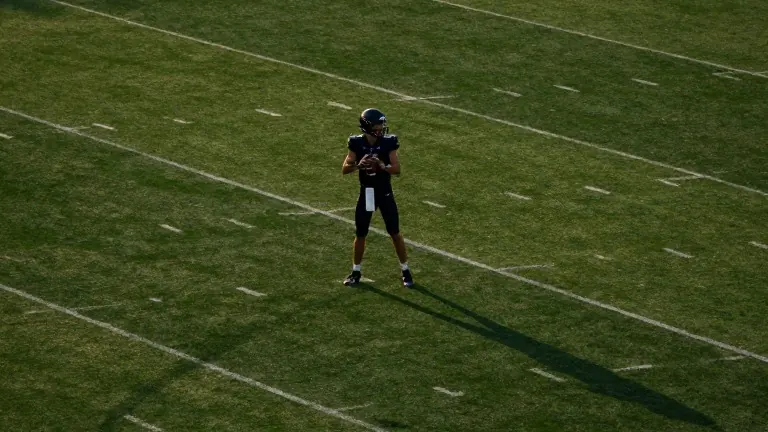
Kelvin Hopkins Jr. became the first player in Army football history to throw and rush for more than 1,000 yards in a single season in 2018. He led the Black Knights to an 11-2 record that year, finishing with 2,143 total yards and 23 touchdowns. Despite these historic marks, Hopkins says he felt constant pressure to fit a traditional profile.
In the first episode of the audio series Kam’s Krystal Ball, titled The Modern Black Quarterback, Hopkins discusses how the label of dual-threat quarterback created distinct challenges. He notes that scouts and coaches often questioned his mental command of the offense, assuming he relied solely on athleticism rather than strategic processing.
"I remember leaving high school where you were either in this dual-threat kind of pocket or you were in this pocket-passer pocket," Hopkins said. As a 5-foot-9 recruit from the Atlantic Coast Conference region, he felt compelled to suppress his running ability to convince college coaches he could operate as a standard pocket passer.
Researchers have documented these patterns in media coverage. A 2010 study by Ball State University and the University of Wisconsin-Oshkosh analyzed 4,700 descriptions of NFL prospects over ten years. It found that Black quarterbacks were more frequently described by their physical traits and doubts about their mental game, while white counterparts were portrayed as cerebral and less prone to mental errors.
A separate study in Communication & Sport examined 3,400 high school recruits between 2001 and 2020. More than 85% of players labeled as pro-style were white, while Black quarterbacks dominated the dual-threat category. A 2013 study from Kennesaw State University and the College of Mount Saint Joseph found that Black high school quarterbacks were significantly more likely to be moved to other positions upon arriving at college.
Recent draft events have reignited these debates. Justin Fields faced criticism from analyst Dan Orlovsky, who questioned his desire to be a great quarterback. Ohio State head coach Ryan Day called the work ethic questions reckless. Orlovsky later apologized to Fields for his comments.
The 2025 NFL Draft brought similar scrutiny to Shedeur Sanders. Son of Pro Football Hall of Famer Deion Sanders, Sanders entered the process as a potential top-two pick. He was selected 144th overall by the Cleveland Browns in the fifth round. NFL executives cited concerns about his character and family background during the draft, a narrative that contrasts with how other prospects with similar traits are evaluated.
NFL media analyst Bucky Brooks posted on Twitter that stereotypes are routinely affixed to Black quarterbacks regarding work ethic, a label rarely applied to non-Black quarterbacks on television. Hopkins argues that the language used to describe quarterbacks has not kept pace with the evolution of the position, where the line between pocket passers and mobile athletes continues to blur.